I really enjoyed having storyteller Jack Dueck speak to us in class on Wednesday. I'm not sure what I was expecting, but whatever my expectations were, Jack exceeded them. I was touched by his dedication to the stories he tells and the way they continue to move him, despite being stories he's no doubt told numerous times.
Jack was full of good little anecdotes about Mennonites, and stories and writing. It was refreshing to see someone so satisfied in what he was doing, especially since (as I've recently been learning in Memoir and Feature Writing) it is rare that writers are able to reap tangible rewards for their efforts. So it's nice to see that even if the rewards of writing aren't tangible, at least they're meaningful.
I particularly enjoyed the story Jack told about the two Mennonite families in a tiff, and despite the tiff one family's son marries the other family's daughter. I thought I detected Jack getting a little emotionaly during the end of this story, and it made me hope that I can someday tell stories that are as meaningful to me as Jack's are to him.
Thursday, February 24, 2011

Monday, February 21, 2011
Searching for Intruders

The first three chapters of Searching for Intruders left me feeling horrible. It's so frustrating to read stories in which none of the characters are sympathetic. I felt disgusted after reading the first 6 stories -- how could someone even write something this depressing? I get writer's block if my character is unsympathetic -- where is the motivation in continuing the story of someone who has little to offer? Or perhaps this is kind of a hedonistic thing to say. I've never been able to acknowledge that pain might have as much value as pleasure, if any at all.
The character of Wilson makes me feel very unhappy. The opening story, Roaches, was repulsive in many ways, least of which was the description of the floor of the apartment swarming with roaches. In Roaches and Floating, the reader gets a fairly strong impression of Wilson being a pretty bad husband/boyfriend. Even the short-shorts set between the chapters don't inspire sympathy in me for Wilson, despite the hardship they hint at.
I read a few more chapters of the book, and it helps expand the story and give me a little reason to empathize with Wilson, but still not much.
There is something to be said, however, for the way that, despite not feeling any sort of connection with the characters, something about them makes me want to keep reading. Though maybe that has to do with having to read it for class. :)
Thursday, February 17, 2011
How Julia Kasdorf Changed My Life
The essays in Danny Cruz's How Julia Kasdorf Changed My Life were hugely varying. While I loved the theme of the essays -- college students discussing their Mennonite identity or how they've been affected by the Mennonite church in some way -- I felt that there were certainly some that succeeded far more than others.
For example, the essay by Ted Houser, who wrote of his appreciation for being a privileged Mennonite growing up in "The County" (which, for all you who, like me, are NOT "insiders," means Lancaster County, PA), an area that was wealthified* by Hans Herr, one of the original Mennonite inhabitants of The County.
The essay's tone made the author seem completely unsympathetic, as he writes about the cars his friends received on turning 16, or the vacation houses of their parents that he and his friends would retreat to on breaks. As both a Mennonite and the daughter of a surgeon, people have always had a mistaken assumption of the wealth of my upbringing, which, while comfortable, couldn't be called anything other than simple in just the way I've been taught "real" Mennonites do it.
I've always found myself ultra-resistant to having an image of wealth. So Houser writing an essay that gives people the impression that Mennonites are wealthy, and proud of it, offends the sensibility of simplicity that I've grown up with and (though total simplicity is no longer something I really conscientiously go for due to its inconvenience) still value.
The essay I particularly enjoyed was Clarissa Gaff's. Gaff covers a wide range of "Mennonite things" while remaining entertaining, and while some are stereotypical, almost cliche Mennonite sentiments and images, Gaff's voice gave them new life. She was candid without being obnoxiously so and this made her essay quite relatable. Plus, Gaff and her siblings grew up in the same church as I did growing up, so maybe I've got a little bias.
*Yes, I know this is not an actual word, but sometimes I feel like the vocabularial* shortcomings of English can be made amends for by employing all those suffixes we so handily borrowed from other languages.
Wednesday, February 2, 2011
The Mennonite poems
I'm really NOT into poetry, prowess in writing stunted lines doesn't impress me, and I usually find it to be a waste of a person's writing talent.
However, I really enjoyed two of the poems from A Capella we were assigned to read.
As far as Julia Kasdorf's Mennonites go, it's the one I enjoy the least, though there is definitely a lot of appeal in how relatable the subject matter is, which can also be said of Mennonite in a Little Black Dress. Kasdorf uses such strong images while also spanning a lot of Mennonite history.
My favorite, Jeff Gundy's poem How to Write the New Mennonite Poem does a lot of really nice things playing with humor and parody. While sometimes I felt like the humor was getting a little base ("...many dead Mennonites were really good. Work in two or three. Dirk Willems is hot this year.") I thought Gundy mostly succeeded in writing a Mennonite poem that both addressed the now-cliches of Mennonite-ism, but also turned them on their head, working in the new stereotypes, drinking exotic coffee, granola, the Peace Tax Fund.
Of the trio of poems, I found David Wright's to be the least relatable, and therefore the one I enjoyed the least. However, it is interesting in that Wright is a Mennonite in a way that is unfamiliar to me, and that is intriguing.
One of the major things these poems brought up in my mind was the issue of audience. THere are many instances in both Gundy and Kasdorf's poems, as well as in MLBD where I feel as though the author is pandering to an audience outside of the Mennonite world, trying through a certain type of humor that I can't quite put a word to (Janzen doing the check-box thing, Gundy talking about liking sex, etc) to make people besides Mennonites like them. Though, of course, I could just be hypersensitive.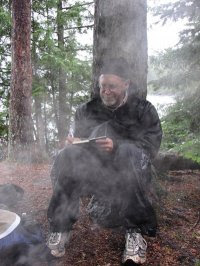 (I love this picture of Gundy, and it makes me like his poem even more)
However, I really enjoyed two of the poems from A Capella we were assigned to read.
As far as Julia Kasdorf's Mennonites go, it's the one I enjoy the least, though there is definitely a lot of appeal in how relatable the subject matter is, which can also be said of Mennonite in a Little Black Dress. Kasdorf uses such strong images while also spanning a lot of Mennonite history.
My favorite, Jeff Gundy's poem How to Write the New Mennonite Poem does a lot of really nice things playing with humor and parody. While sometimes I felt like the humor was getting a little base ("...many dead Mennonites were really good. Work in two or three. Dirk Willems is hot this year.") I thought Gundy mostly succeeded in writing a Mennonite poem that both addressed the now-cliches of Mennonite-ism, but also turned them on their head, working in the new stereotypes, drinking exotic coffee, granola, the Peace Tax Fund.
Of the trio of poems, I found David Wright's to be the least relatable, and therefore the one I enjoyed the least. However, it is interesting in that Wright is a Mennonite in a way that is unfamiliar to me, and that is intriguing.
One of the major things these poems brought up in my mind was the issue of audience. THere are many instances in both Gundy and Kasdorf's poems, as well as in MLBD where I feel as though the author is pandering to an audience outside of the Mennonite world, trying through a certain type of humor that I can't quite put a word to (Janzen doing the check-box thing, Gundy talking about liking sex, etc) to make people besides Mennonites like them. Though, of course, I could just be hypersensitive.
 (I love this picture of Gundy, and it makes me like his poem even more)
Thursday, January 27, 2011
Thoughts on Mennonite in a LBD

Reading Rhoda Janzen's memoir riles me up a little bit. I feel at times like she's being a little too flippant, boiling Mennonites down to the stereotypical bits like borscht and a Quirky mother (as Jeff Gundy puts it). While it's fine and even fun to read these little Mennonite "inside jokes" (borscht- haha, it turns your tupperwares pink, etc) I get a little frustrated with Janzen for taking the easy way out with these things.
Of course, I justify what she does by saying she needs and was intending to reach a wider audience than just Mennonites, and in attempting to do so must de-dynamize some of what she writes.
At times it seems to me as though she's trivializing a community that I feel a very strong tie to, that I truly love and feel fortunate to belong in.
Which brings me to the question I asked in my previous post, which was, in thinking about MLBD in relation to Pearl Diver, Why does Janzen choose to tell the stories she does and where might she have taken a cue from Hannah and chosen to leave something out in respect to her community or someone she was close to?
Though Janzen does have some fairly interesting and honest and insightful things to say about growing up in a Mennonite family and really speaks to me as a reader in the way that I feel I can relate to the way she's grown up and the struggles she faces as a person nebulously of the Mennonite faith today, she still strikes me as taking advantage of the quirks and intricacies of the Mennonite community to sell her book (oh my goodness! a Menno in a little black dress -- so scandalous! she talks about tits, what a rebel!). I wish she didn't rely so heavily on generalizations and shock value for the success of the story.
Which all makes me feel more negatively in retrospect than I actually feel while reading the book. It's an engaging, entertaining read, which makes me struggle all the more with the question I asked in my last post, and feel like I'll be asking throughout this class, "How does a writer decide what stories to tell, especially a writer that feels they owe something to someone or some community?"
Wednesday, January 26, 2011
Pearl Diver Response
What interested me most about Pearl Diver is what affects me the most as a (wannabe) writer: Hannah's dilemma in knowing what to write, how to write about it, and who it affects. There is always the question, in writing, about what stories need to be told, what stories do people need to hear.
I was very interested to see how Hannah handled this, because she very obviously NEEDED to tell the story of her mother's murder. She had the same thing happen as I do when I have inspiration and find myself needing to write about something -- she sat down and just wrote and wrote and wrote. We get the impression that writing is cathartic for her (as, obviously, it is for lots of writers.. big deal, Annie), and so, by the end of the movie, regardless of the revelation that's just been made about Sam's innocence, I desperately wanted her to publish the story, if only because there is something about the story that needs to be told, and I can empathize with Hannah in the way that I don't want her to waste everything she's just done. Though, obviously, it made a much better movie that she tossed the pages into the pond, however painful it was to see all that hard work literally washing away.
This ending didn't help me at all grapple with "What is the role of the Mennonite writer?" because our example in Hannah leads us to believe that our role is first to be a Mennonite, and only if writing fits peacefully into that lifestyle should we attempt it. Or at least that's how I interpreted it.
This tied in well with our class discussion of Mennonite in a Little Black Dress today. Though obviously there were different circumstances involved in Rhoda Janzen's life and the lives of Marion and Hannah, I find it interesting to think about why Janzen told what she told of her story, and whether or not she should have taken a page from Hannah's book (not literally. Heh) and chosen to respect the feelings of people she loves or once loved, or even Mennonites in general, instead of cashing in on their stories, which is what I felt she was doing at times.
The other aspect of the movie that I found particularly interesting, especially as an ethnically Mennonite viewer who spent a lot of my most formative years bumming around the town in which this movie was filmed, was how the film painted and explored the differences between Hannah and Marion as characters and the worlds they inhabit, and used these differences to speak to larger issues of what it means to be a Mennonite today, and how "ought" Mennonites to behave/believe/dress, etc? Though at times, as an "insider" in this world, I found myself getting a little frustrated with the use of stereotype in portraying the sisters, I also found a lot of things about their identities resonating with me, as someone who is neither a city mouse Mennonite like Hannah or a country mouse Mennonite like Marion, but perhaps a college mouse for now.
Monday, January 24, 2011
THIS IS SO EXCITING
my very first blog.
it's going to be about mennonite literature.
EDITOR'S NOTE: "my very first blog." CORRECTION: this was misleading. this, apparently, is my 2nd blog, though hopefully it won't also vanish from my memory as did the first one.
it's going to be about mennonite literature.
EDITOR'S NOTE: "my very first blog." CORRECTION: this was misleading. this, apparently, is my 2nd blog, though hopefully it won't also vanish from my memory as did the first one.
Subscribe to:
Posts (Atom)